Most owners treat growth and exit as two different projects. Grow now, and worry about selling “one day”. Then one day arrives, and the business that took twenty years to build needs two years of fixing before a buyer will pay what it’s worth.
Here is the thing: the work is the same. The practices that make a business valuable to a buyer are exactly the practices that make it grow — and make it easier to run on a Tuesday morning.
Value is the common thread
A buyer pays for profit they can rely on, risk they can manage and a business that keeps working after the owner leaves. Strip away the deal language and that’s also what every owner wants today: dependable earnings, fewer surprises and a business that doesn’t need them in every decision.
So value building isn’t an exit strategy. It’s a growth strategy with an exit option built in. The only things that change with your plans are priority and timing.
Five value drivers, two payoffs
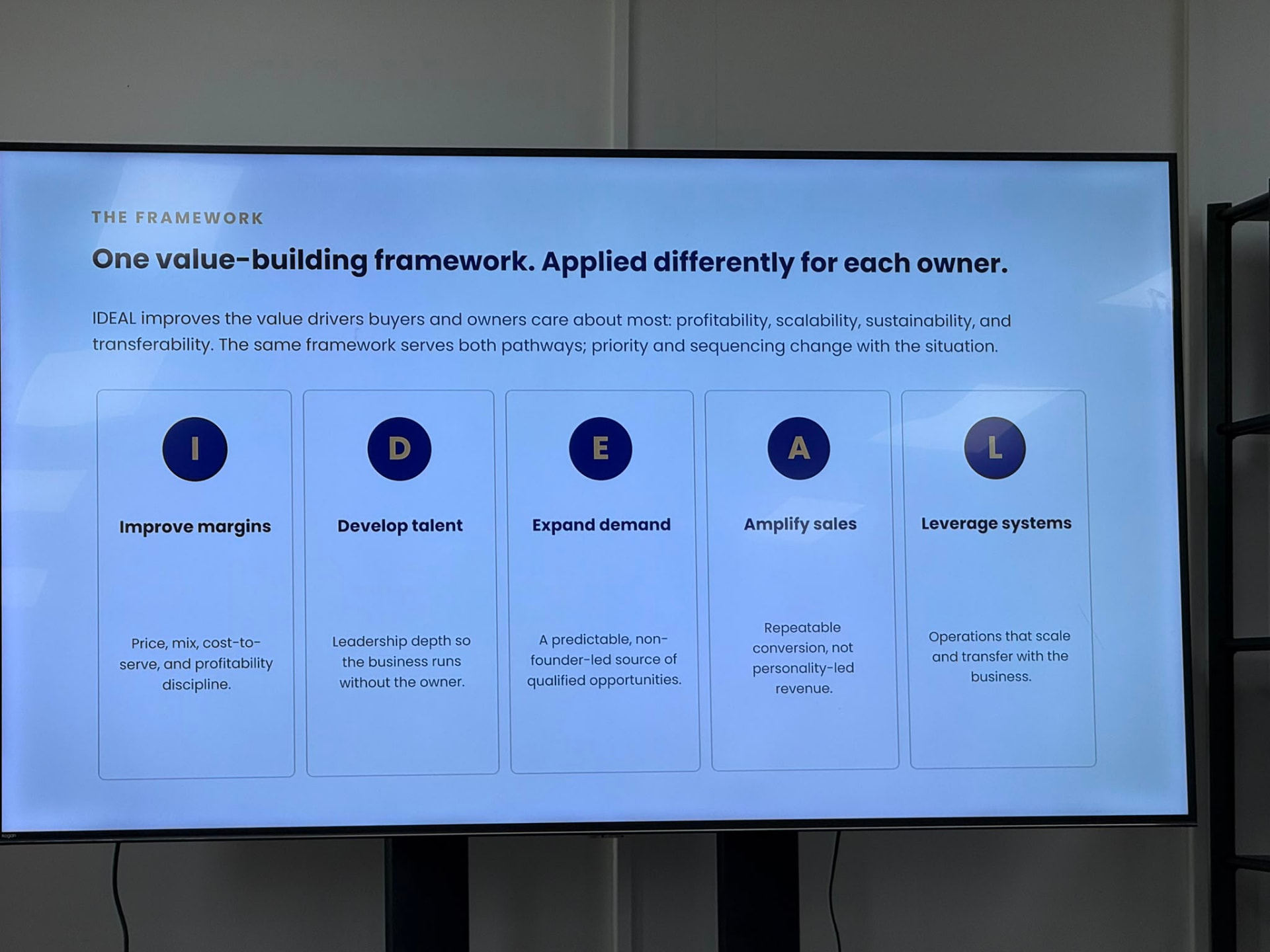
Our IDEAL framework focuses on the drivers buyers and owners care about most — profitability, scalability, sustainability and transferability.
- I
Improve margins
Price, mix and cost-to-serve. Better margins fund growth now and lift the earnings a buyer pays a multiple on later.
- D
Develop talent
Leadership depth so the business runs without you. You get time back today; a buyer gets a business that doesn’t walk out the door with the owner.
- E
Expand demand
A predictable, non-founder-led source of qualified opportunities. Easier to plan around, and far easier for a buyer to believe in.
- A
Amplify sales
Repeatable conversion, not personality-led revenue. A sales process anyone can follow is a sales process that transfers.
- L
Leverage systems
Operations that scale and transfer with the business. Fewer fires today, fewer due diligence questions tomorrow.
An exit-ready business is simply an easier business to run today.
Why exit-ready means easier now
When the numbers are clear, decisions are quicker. When the team can lead, you can take a holiday without your phone. When work comes in from a system rather than your network, you can plan hiring with confidence. None of that requires a sale on the horizon — but all of it shows up in the price if one comes.
Five things you can start tomorrow
1.Write down the three things only you can do
List every task that stalls when you’re away. Pick one and decide who will own it within 30 days. That is the start of owner independence.
2.Look at last month’s numbers by job, product or customer
Not just the total. Find the work that earns the least for the effort and ask whether to reprice it, redesign it or stop doing it.
3.Document one process you repeat every week
Quoting, onboarding, invoicing — whichever causes the most questions. A one-page checklist is enough. Then let someone else run it.
4.Find where your next ten customers will come from
If the honest answer is “people who know me”, name one channel that doesn’t depend on you and test it this month.
5.Put your key agreements in one folder
Customer contracts, supplier terms, leases, employment agreements. Note what is missing, expired or verbal. A buyer will ask — and you’ll run tighter for knowing.
Your next move
Pick one of the five and do it this week. Then ask a harder question: if a buyer looked at your business tomorrow, where would they discount the price? Those gaps are also where your growth is stuck.
General information only, not legal, tax or valuation advice.